
The Economic Turing Test
Long have we passed the point of whether a computer could have a conversation with you without you knowing. But can a machine really take away your job?

In 1950, Alan Turing asked if a machine could convince you it's human through conversation. Today, a more pressing question emerges: Can AI do your job so well that your boss wouldn't know the difference?
I heard this term for the first time on the Lenny Podcast with Ben Mann, co-founder of Anthropic and former architect of GPT-3 at OpenAI. This test asks whether an AI agent can perform economically valuable work indistinguishably from a human worker. When the AI consistently gets the job, we've crossed into what Mann calls "transformative AI", the moment machines stop being tools and start being colleagues (or … replacements).
The White-Collar Automation Wave
Dario Amodei recently made a prediction that cuts through the usual AI optimism: AI could eliminate half of all entry-level white-collar jobs within five years, potentially pushing unemployment to 10-20%.
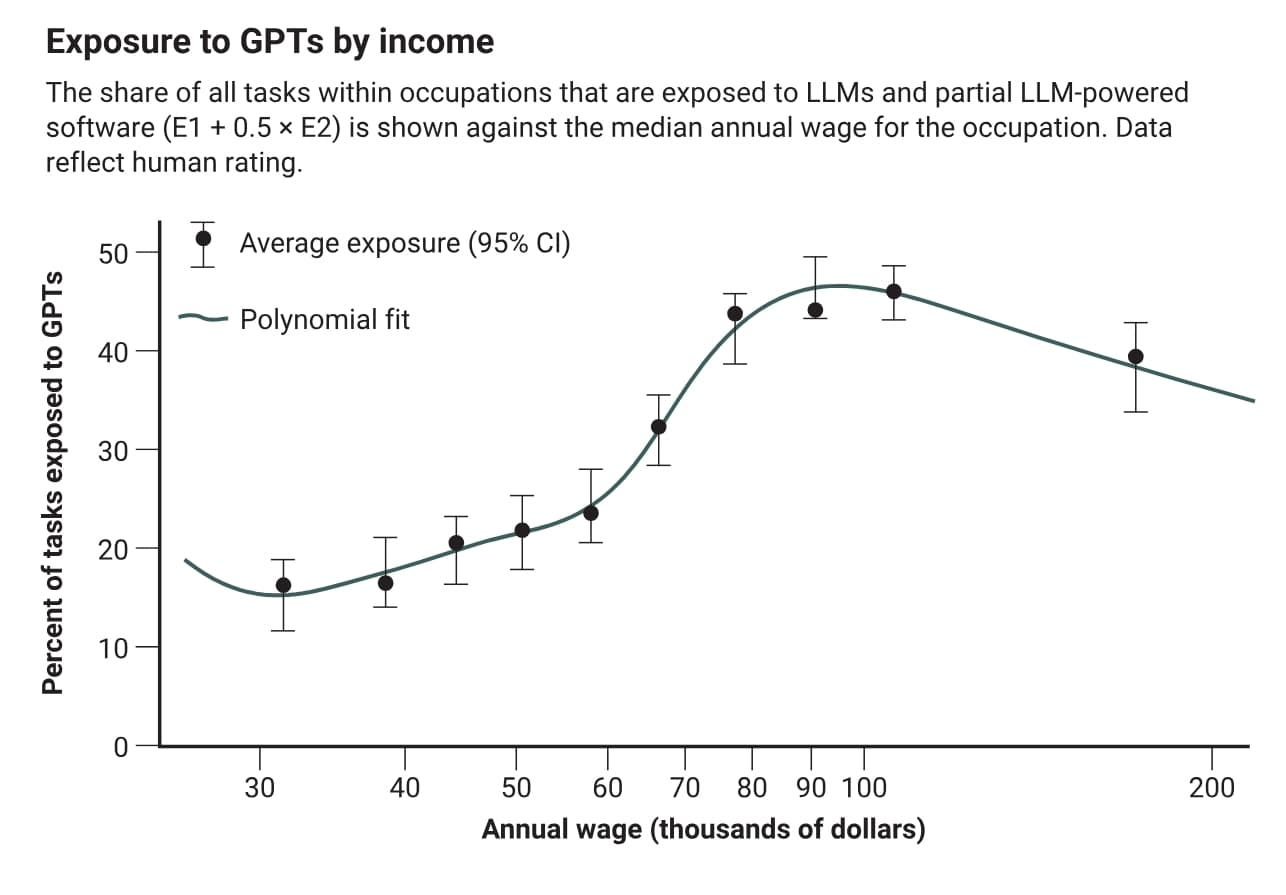
A recent study attempted to chart out the exposure to GPT’s as a function of the general annual wage of the person. It is important to note that the Y axis represents the percentage of tasks that are exposed to GPT’s and not the percentage probability of completely automating the task. It is unsurprising that the graph peaks at around $90000 per year as the workers in that tier are primarily lower level knowledge workers who use a computer (something AI has become very good at). It is, however, interesting to note that there two ways one may interpret these results. On the one hand, AI-doomers will be quick to catch how unsafe some factions of society are, but, on the other, this represents an opportunity for workers to be more productive and focus more on what matters.
The Economic Turing Trap
There is a term for what happens when we build AI to replace humans instead of working alongside them: the "Turing Trap." It's not just about job displacement, it's about how economic power gets concentrated when technology owners hold all the cards.
MIT economists studied four decades of wage data and found something significant: between 50-70% of America's growing wage inequality comes from automation displacing workers.
This helps explain why many people feel economically squeezed despite overall productivity growth. The pattern is straightforward but consequential:
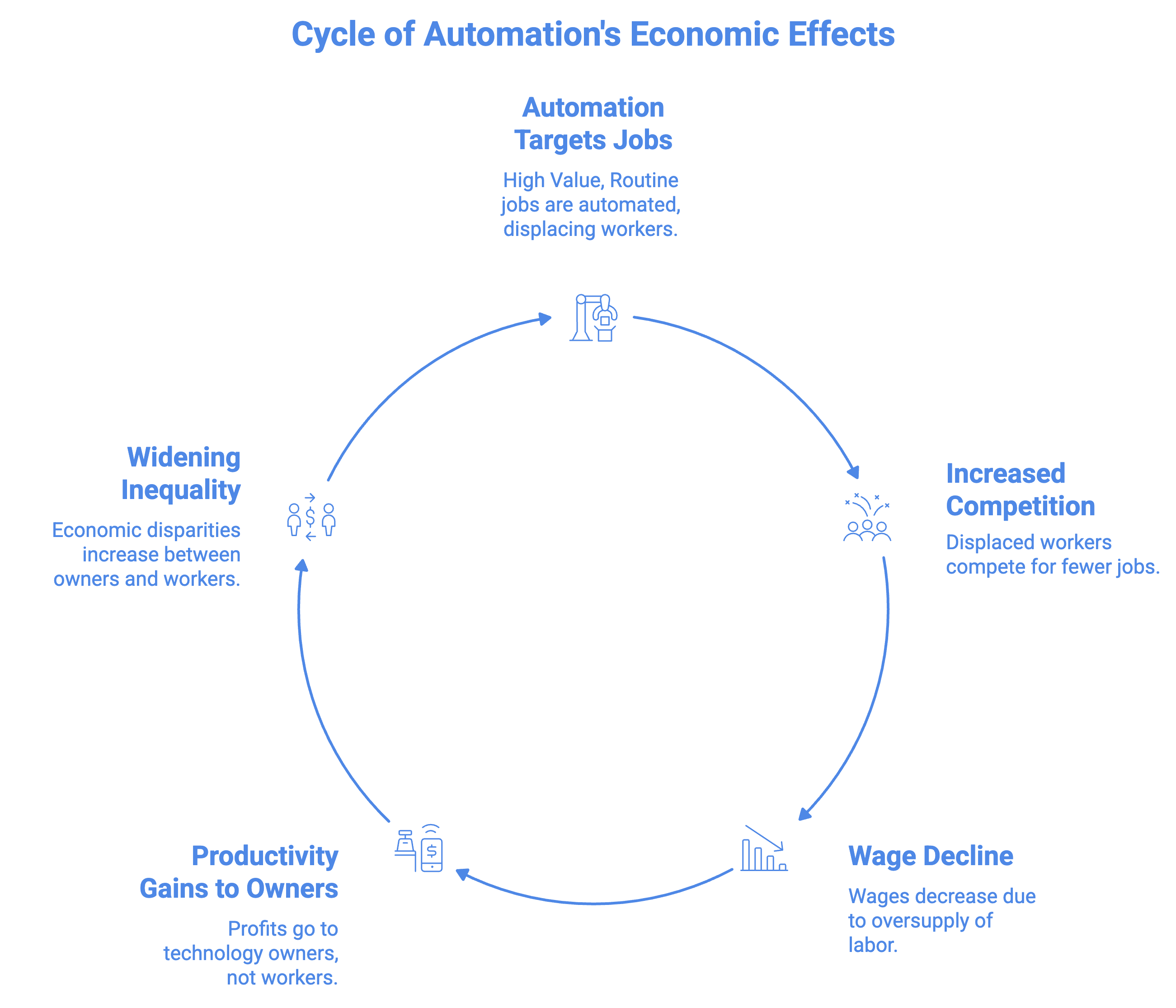
What makes today's automation different from past technological shifts is its focus on replacement rather than job creation. Previous innovations opened new industries and roles. Current automation is more substitutive, designed to do exactly what humans do, just more efficiently.
Beyond the Trap: Augmentation vs. Annihilation
Consider the images below. These are real images and posts from real companies. How do they make you feel?
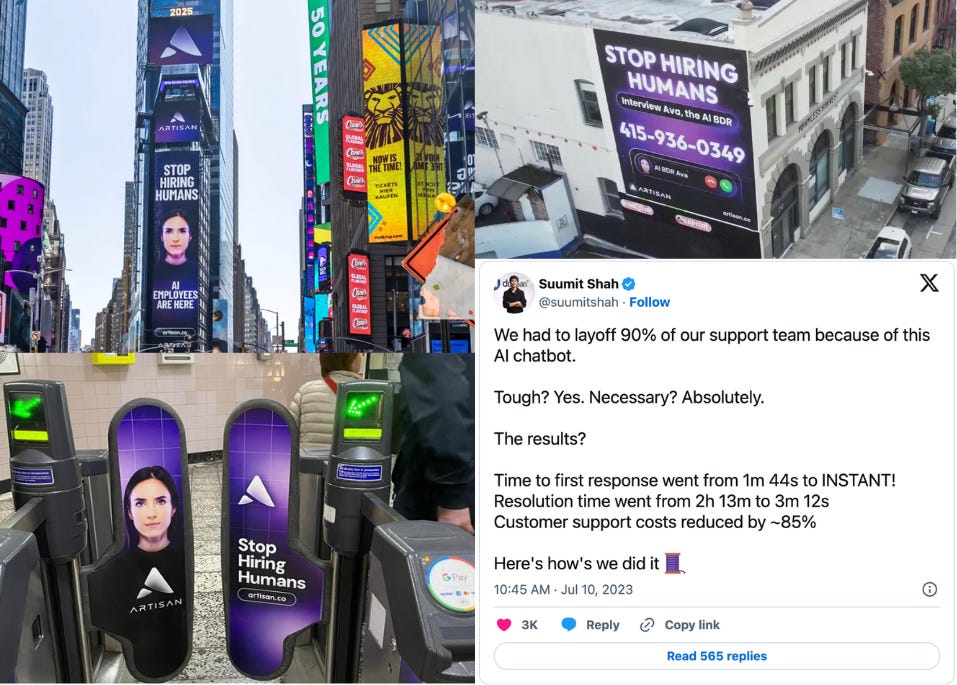
Augmentation multiplies human capability. Automation simply erases it. The first path creates more skilled, more valuable workers. The second creates unemployment lines.
What's maddening is watching companies default to replacement. They see AI as an expense reducer, not a human amplifier. But strip away the hype, and there's something irreplaceable about how we think - our ability to read the room, to understand what someone really means, to navigate contradictions that would break any training algorithm. We are able to handle the last mile nuance for most problems that just cannot be automated yet.
The Test Ahead
The Economic Turing Test isn't coming - it's here. Claude can already code for hours without supervision. ChatGPT agent has its own computer to use. The countdown has begun.
But unlike Turing's original test, this one comes with a choice. We can sleepwalk into a future where algorithms replace workers and concentration of power reaches feudal levels. Or we can intentionally build cultures where AI makes humans more capable, more creative, more essential. The window for this choice is closing fast. Once AI passes the Economic Turing Test in enough domains, market forces take over. Companies that replace workers will outcompete those that augment them - unless we change the rules of the game first.
The question isn't whether AI will transform work. It's whether that transformation will transform us into obsolete appendages or into something more human than we've ever been.
References
GPTs are GPTs: Labor market impact potential of LLMs - https://www.science.org/doi/10.1126/science.adj0998
AI’s impact on income inequality in the US - https://www.brookings.edu/articles/ais-impact-on-income-inequality-in-the-us/
AI Could Actually Help Rebuild The Middle Class - https://www.noemamag.com/how-ai-could-help-rebuild-the-middle-class/